

The complete guide
How to Choose a Slim Leather Wallet That Actually Fits Your Pocket
The problem with the wallet you already own
Think about the wallet in your pocket right now. It probably started life thin. Then a bank card joined, a transit card, an old gym membership, a couple of receipts you meant to throw out in March. Over a few years it quietly doubled in thickness, and now it pushes your pocket out of shape and sits under you when you drive.
Most people do not replace that wallet because it stopped working. They replace it because they got tired of the bulge. A slim leather wallet solves that by removing the choice. There is only so much room, so only the cards you actually use make the cut.
This guide walks through how a front pocket card case works, who it suits, how to choose a size, and how to keep leather looking decent over time.
How a slim card case is different
A traditional bifold folds in half, which means every card you add gets counted twice in thickness. Fold a stack of seven cards and you are suddenly carrying fourteen cards' worth of depth, plus the leather on both sides, plus whatever notes are tucked into the back.
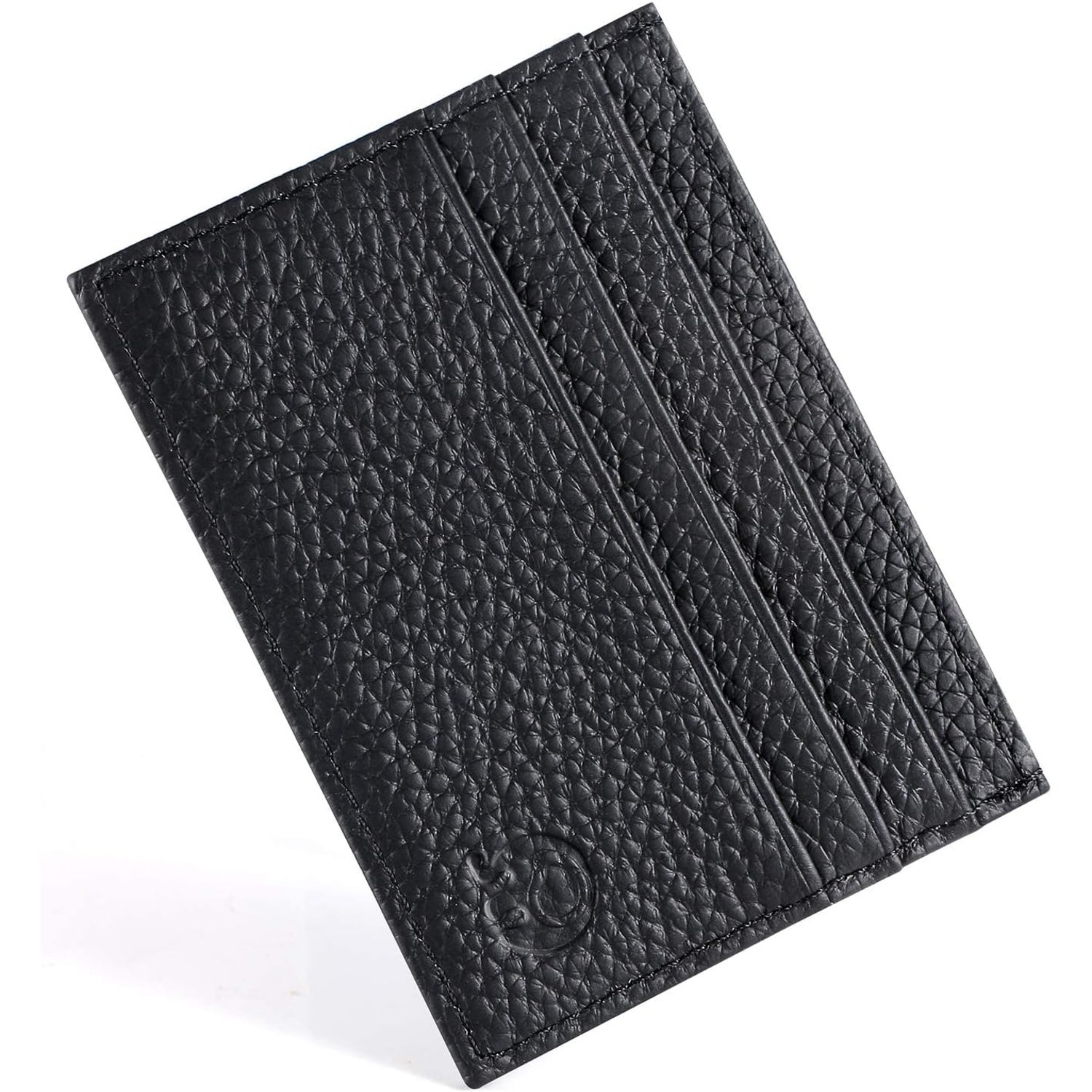
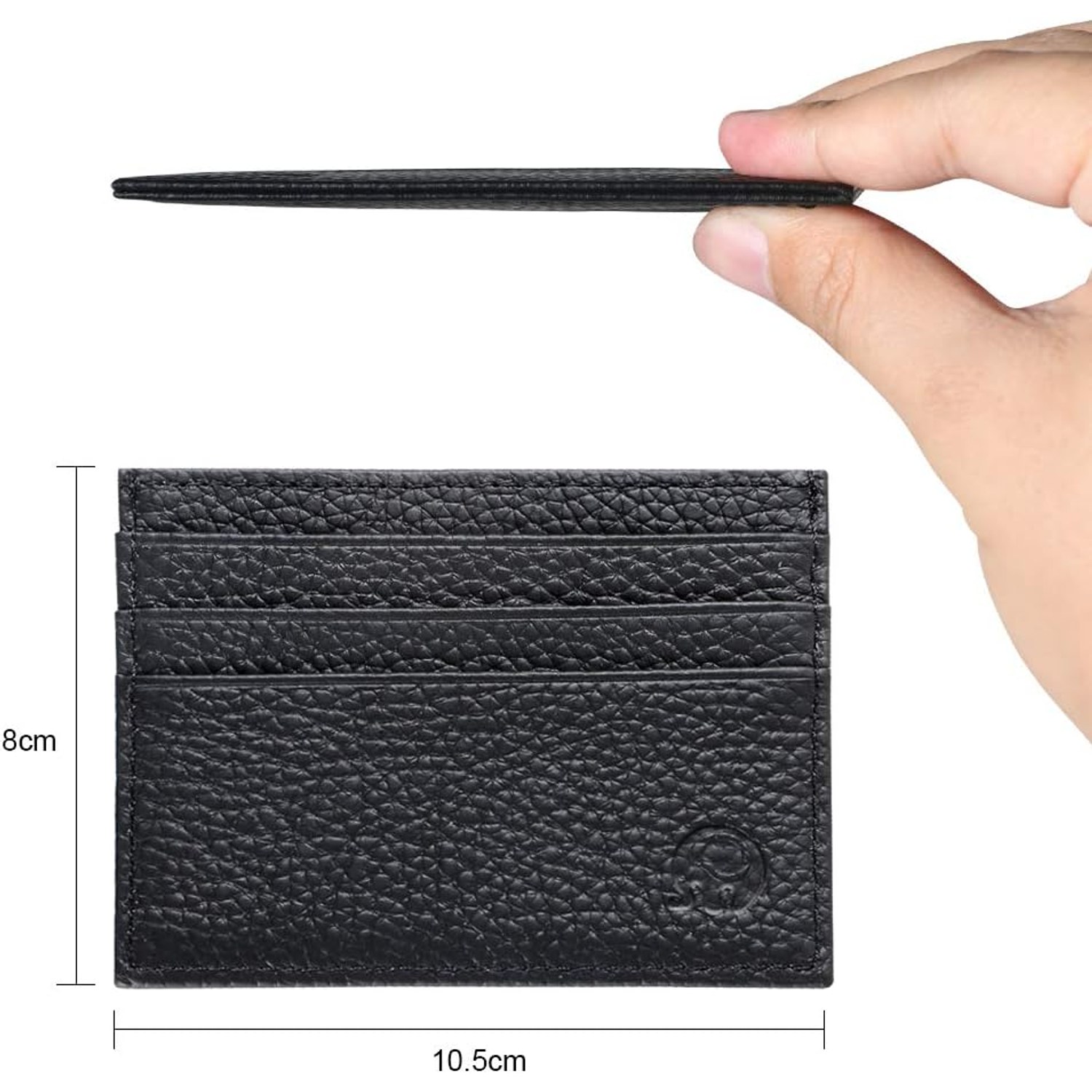
A flat card case does not fold. Cards lie against each other in a single plane. This wallet measures 10.5 x 9 x 0.7 cm, which is close to the footprint of your bank card with a small border around the edge. Loaded, it adds a few millimetres, and that is it.
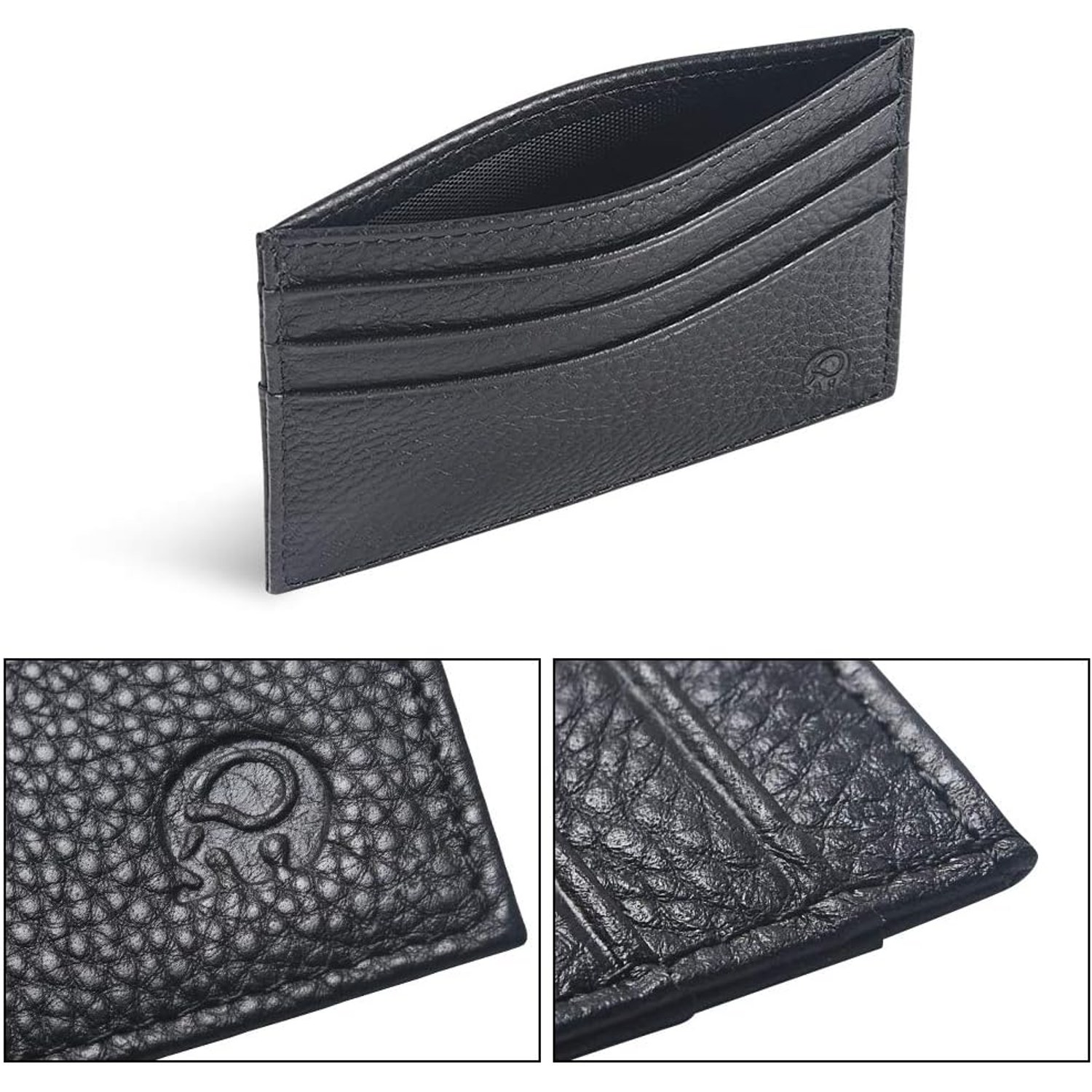
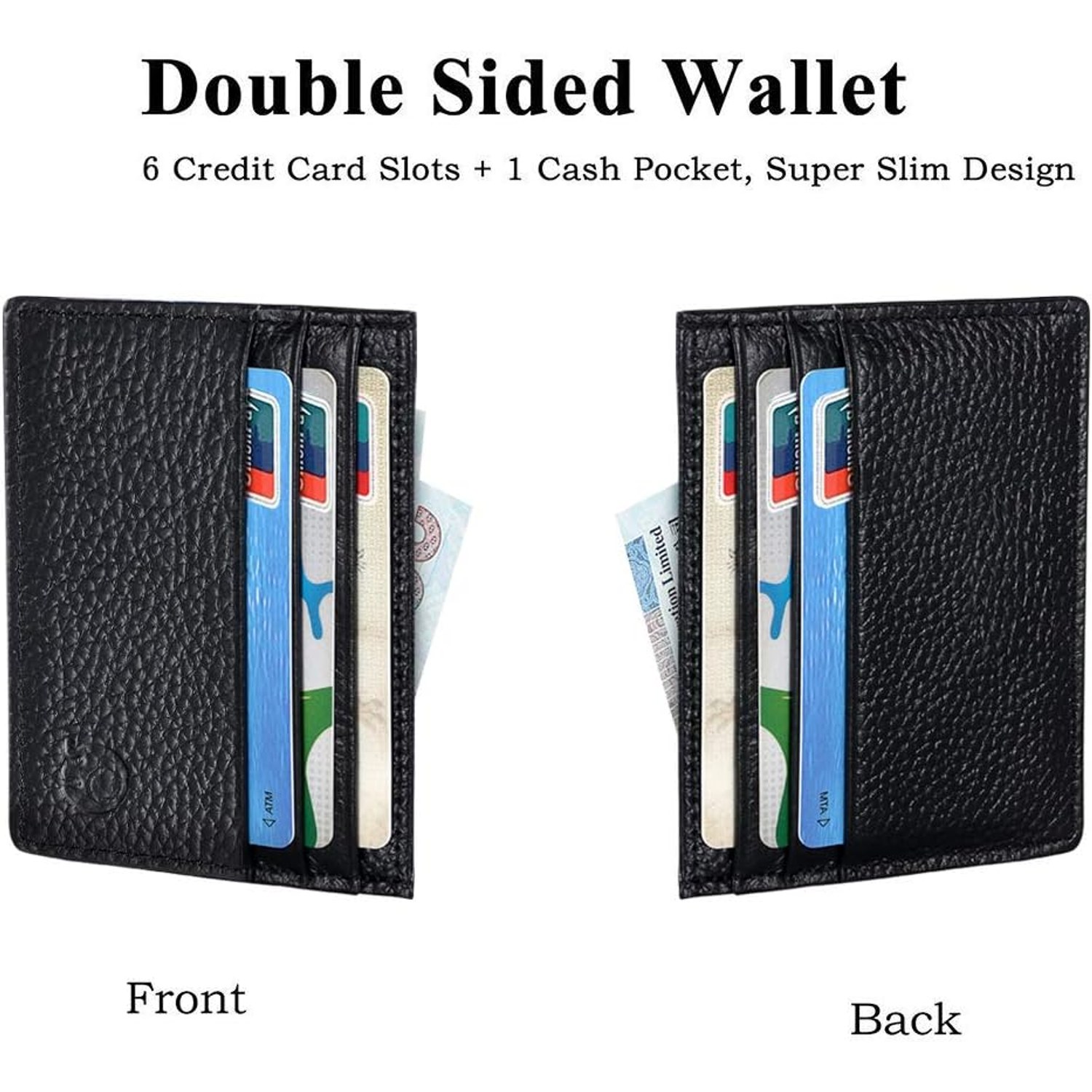
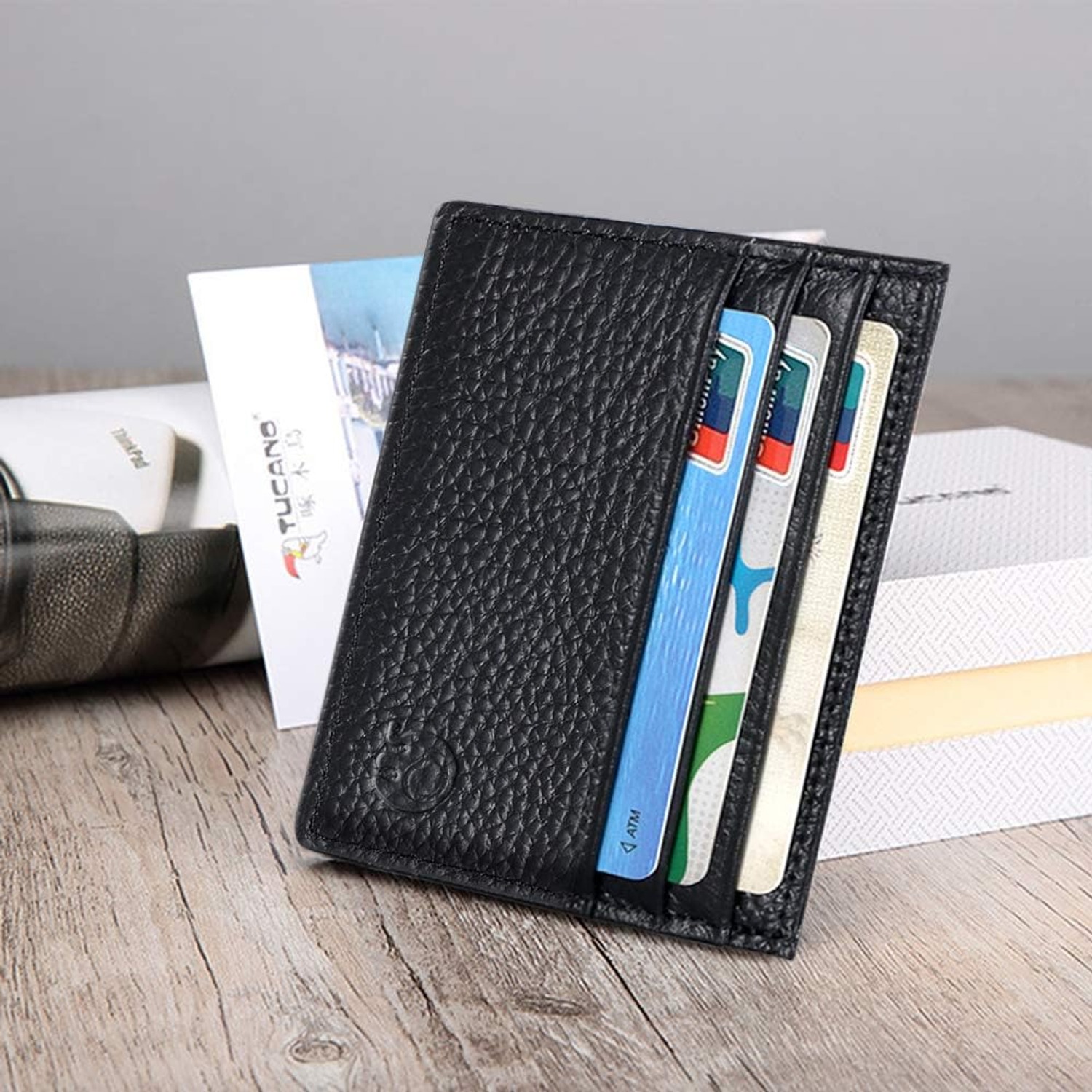
The slot layout here is three on one face, three on the other and one running through the centre, which gives seven in total. Each slot takes one or two cards. The open top means there is no snap, no zip and no flap. You tilt the wallet, push with your thumb, and the card comes up.
That sounds like a small thing until you are at a ticket gate with people behind you. Fewer steps between pocket and card reader is genuinely useful.
Who this style suits
A minimalist front pocket wallet is a good fit if you tap more than you pay cash, if you have a short list of cards you reach for daily, or if you have ever had back pain from sitting on a thick back pocket wallet.
It also suits commuters, since a travel card can live in its own outer slot and never get hunted for. People who go between a work bag and a jacket like it because it is flat enough to move between pockets without a second thought.
It is less suited to a few situations. If you carry coins every day, you will want a separate pouch, because there is no coin compartment here. If you keep a loyalty card for every shop you have ever visited, seven slots will feel tight. And if you need a folded stack of banknotes on you, this is not that wallet. A couple of folded notes in the centre slot is the realistic limit.
Be honest about which group you are in. A compact card wallet that forces you to ditch eleven cards you genuinely use is not an upgrade, it is a daily annoyance.
Working out how many cards you actually need
Here is a quick exercise before you buy any low profile wallet. Empty your current wallet onto a table and sort everything into two piles. Pile one is what you have used in the last month. Pile two is everything else.
Most people find pile one has four to seven items. Bank card, a second card as backup, a driver licence or ID, a transit card, a work access card, maybe a health card. That is the pile a slim card case is built around.
Pile two usually contains store loyalty cards that live in an app anyway, an expired card or two, a membership you renew annually, and old receipts. Photograph anything with a number you might need, then put the rest in a drawer at home. You will almost never go back for it.
Once you know your real number, the seven slot layout either works or it does not, and you can choose with confidence instead of hoping.
How to load it well
There is a right way to fill a pocket wallet with card slots, and it saves you grief later.
Put the card you use most in an outer slot, on the side that faces your hand when you pull the wallet out. Muscle memory does the rest within a week. Put rarely used cards in the centre slot, since that is the slowest one to reach.
Avoid cramming three or four cards into one slot. Leather does stretch, and a slot stretched by a permanent overload will not grip properly again. One or two cards per slot is the sweet spot, and it keeps the whole case flat.
If you carry notes, fold them in half or thirds and slot them through the centre rather than stuffing them along one side. That keeps the weight balanced and stops the wallet wedging open.
Looking after leather without fuss
Leather care gets written about like it needs a weekend ritual. For an everyday card holder it really does not.
The care instruction for this item is dry cloth cleaning. Wipe the outside with a soft dry cloth now and then to lift off pocket dust and skin oils. That is most of the job.
Keep it away from standing water. If it gets caught in rain, take the cards out and let it air dry at room temperature. Do not park it on a radiator or in front of a heater, because drying leather fast is what makes it stiff and prone to cracking. Patience beats heat every time.
Avoid long stretches in strong direct sunlight on a car dashboard, which fades finishes. Skip household cleaners and solvents entirely. And never put it through a washing machine or tumble dryer.
With that small amount of attention, a leather card holder develops the softened, slightly darker look that most people actually prefer to the brand new version.
What to check before you buy any slim wallet
A few practical points worth comparing across models.
Slot count and layout matters more than overall size. Seven slots split across two faces and a centre pocket behaves differently from seven slots stacked on one side, which gets wedge shaped when full.
Closure type affects speed. An open top is the fastest to use and the least likely to wear out, because there is no mechanism. A zip holds more securely but adds thickness and a part that can fail.
Thickness when empty tells you the floor, not the ceiling. This one is 0.7 cm empty. Add your cards to get the real number for your pocket.
Finally, check what is actually stated about the product rather than assumed. Colour, material and country of origin are not specified in this record, and RFID blocking is not listed either. If any of those are deal breakers for you, it is better to know that up front than to guess.
The short version
A slim leather wallet is a small change that you notice every single day. Your pocket sits flat, your card is in your hand faster, and the slow creep of junk accumulating in a folded wallet simply stops because there is nowhere for it to go.
This one gives you seven slots, an open top for quick access, and a 10.5 x 9 x 0.7 cm body that disappears into a front pocket. Spend ten minutes sorting your current cards into two piles, decide if your real daily number fits inside seven, and if it does, this is an easy switch to make.
If it turns out not to suit how you carry things, tell us what did not work and we will help you find something better matched from the range.